

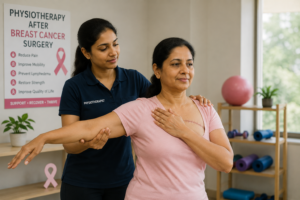
Physiotherapy After Breast Cancer Surgery: What to Expect in Your Recovery Journey
The surgery is done. The ward round is over. You are handed a leaflet with some basic exercises, told to “take it easy,” and sent home.
For most women in India who undergo breast cancer surgery — whether a lumpectomy, mastectomy, or modified radical mastectomy — that leaflet and that general advice is where the rehabilitation ends.
It shouldn’t be. And if you are reading this after your own surgery, or supporting someone you love through theirs, this article is going to tell you exactly why physiotherapy is not optional — and what a proper, structured recovery actually looks like.
Why Rehabilitation After Breast Cancer Surgery Is Seriously Undervalued in India
Breast cancer is the most commonly diagnosed cancer among Indian women, according to the Indian Council of Medical Research. With survival rates improving steadily over the years — thanks to earlier detection and better treatment protocols — the focus is now rightly shifting to what happens after the treatment ends.
The problem is that breast cancer surgery, while life-saving, does not leave the body untouched. It creates a cascade of physical consequences that don’t go away on their own. A 2024 review published in JAMA Surgery tracking patients after breast cancer surgery found that early structured exercise produced superior recovery in shoulder function, less muscle mass loss, and improved quality of life — with 100% adherence to supervised sessions and 97% adherence to home exercises among participants.
Yet in India, the reality is that most women are sent home with a pamphlet.
The side effects of breast cancer surgery that physiotherapy directly addresses include:
- Shoulder pain and restricted movement — affecting a significant proportion of patients post-surgery
- Arm weakness and reduced grip strength from muscle and nerve disruption
- Scar tissue and adhesions — especially after mastectomy and axillary lymph node dissection, which can cause tightening and pulling sensations
- Lymphedema — persistent arm swelling affecting roughly 1 in 5 breast cancer survivors, as established by a systematic review of 72 clinical studies involving nearly 30,000 women
- Cording (axillary web syndrome) — a painful, rope-like band that appears in the armpit weeks after surgery
- Numbness, tingling, and nerve pain in the arm, chest wall, or armpit area
- Postural compensation — many women unconsciously hunch the shoulder inward after chest surgery, causing neck and upper back problems over time
- Cancer-related fatigue and deconditioning
These are not rare complications. They are common. They are also treatable — but only if you seek the right rehabilitation at the right time.
What Surgery Actually Does to Your Body
Understanding why physiotherapy helps starts with understanding what surgery does to the body.
Mastectomy and lumpectomy remove breast tissue, disrupting chest muscles, skin, and surrounding soft tissue. The surgical scar can form adhesions — where layers of tissue stick together — that restrict movement and create pulling sensations for months afterward.
Axillary lymph node dissection (ALND) or sentinel lymph node biopsy (SLNB) removes lymph nodes from the armpit to check whether cancer has spread. The axilla is an anatomically crowded space — lymphatic vessels, nerves, blood vessels, and tendons all pass through it. Removing nodes disrupts lymphatic drainage from the arm and can irritate or damage nearby nerves.
Then add radiation therapy, which causes progressive fibrosis of soft tissues that compounds over months and years. And chemotherapy, particularly taxane-based agents like paclitaxel and docetaxel, which are known to cause peripheral nerve damage and increase lymphedema risk.
Without structured rehabilitation, many women plateau at a level of physical function well below where they were before treatment — not because they can’t recover, but because they never received the guidance they needed.
What the Research Actually Says
A randomised controlled trial published in BMC Cancer (Rietman et al.) followed 30 patients after breast cancer surgery and axillary lymph node dissection. One group received structured physiotherapy — exercises, shoulder mobilisation, and scar massage. The other received a standard leaflet. At both three and six months, the physiotherapy group showed significantly better shoulder mobility, less pain, and better quality of life.
The “leaflet group” did not come close.
A comprehensive 2023 review published in Musculoskeletal Surgery (Lanzarin et al., University Polyclinic Foundation A. Gemelli IRCCS, Rome) analysed over a decade of rehabilitation studies and concluded: “Both physiotherapy alone or in combination with other techniques significantly improves shoulder disability, pain, and quality of life of patients undergoing breast cancer treatment — regardless of their baseline characteristics or the time passed from surgery.”
The key word there is regardless. Whether you start physiotherapy six weeks after surgery or six months later, it still produces meaningful improvement. But starting early consistently produces better outcomes, faster.
Your Recovery Timeline: What to Expect Phase by Phase
Phase 1 — The First 1 to 4 Weeks
This is the acute recovery phase. Movement is gentle and intentional. Your physiotherapist will focus on:
- Gentle shoulder range-of-motion exercises — keeping movements initially below shoulder height to reduce seroma risk and avoid stressing the healing wound
- Breathing exercises — particularly important after general anaesthesia to support lung expansion and prevent pulmonary complications
- Posture awareness — identifying and gently correcting the forward shoulder posture that begins forming as a protective reflex
- Wound and scar education — understanding how your incision is healing, and when scar mobilisation can safely begin
- Lymphedema education — learning the early warning signs, which activities to modify, and how to care for the skin to prevent infection
Phase 2 — Weeks 4 to 8
As wound healing progresses, physiotherapy becomes progressively more active:
- Shoulder range-of-motion progression — gradually working toward full overhead reach through targeted exercises
- Scar tissue mobilisation — gentle techniques to prevent adhesions from restricting movement permanently
- Cording treatment — if axillary web syndrome has developed, specific release techniques can address it effectively
- Strengthening exercises for the arm, shoulder blade stabilisers, and upper back
- Lymphedema surveillance — limb circumference measurements at each session to detect fluid changes early
Phase 3 — 2 to 6 Months and Beyond
This phase is where rehabilitation expands to restore full functional capacity:
- Progressive resistance training — now strongly supported by evidence as safe for breast cancer survivors, including those with lymphedema
- Aerobic conditioning — walking programmes, swimming, or cycling, adapted to your lymphedema status and fatigue levels
- Return to activity guidance — whether you want to return to yoga, household tasks, or desk work, your physiotherapist builds a safe, progressive plan
- Ongoing lymphedema management — if lymphedema has developed, Complete Decongestive Therapy (CDT) is initiated as part of your sessions
Axillary Web Syndrome (Cording): The Common Complication No One Warns You About
Cording, or axillary web syndrome, affects a significant number of women after breast cancer surgery and is frequently dismissed or misunderstood.
It occurs when the lymphatic vessels and connective tissue under the arm form a tight, cord-like band following axillary surgery. It typically appears 2 to 8 weeks after the operation and causes:
- A visible or felt cord running from the armpit down the inner arm, sometimes reaching the wrist
- Significant restriction and pain when raising the arm overhead
- A sharp pulling sensation when extending the elbow
Women who develop cording are often told it will “go away on its own.” Sometimes it does. More often, it persists and worsens without treatment. Physiotherapy — specifically soft tissue release, gentle progressive stretching, and nerve mobilisation — is highly effective, often producing meaningful improvement within just a few sessions.
Lymphedema After Breast Cancer Surgery: Prevention Is Everything
Lymphedema is the long-term complication that breast cancer patients fear most. The good news is that early physiotherapy intervention makes a genuine difference.
Ideally, your physiotherapist should measure your arm circumference before surgery to establish a baseline. Any increase of more than 2 centimetres in subsequent measurements is a clinical indicator of early lymphedema — and at that stage, Complete Decongestive Therapy (CDT) is most effective, achieving median reductions of over 66% in excess limb volume when started promptly.
Your physiotherapist will also teach you the earliest signs of lymphedema, which activities to avoid and which are safe, skin care practices that reduce infection risk, and how and when to use compression garments.
The Psychological Side of Recovery: Why It Belongs in This Conversation
Recovering from breast cancer is not only physical. Surgery changes the way your body looks and feels. The fear of recurrence, the disruption to body image, the anxiety about whether moving the arm is safe — these are all real, and they affect how well a person recovers physically.
Research consistently shows that structured physical activity after breast cancer treatment reduces anxiety, depression, and cancer-related fatigue, while improving self-image and quality of life. Working with an oncology-trained physiotherapist means working with someone who understands the whole picture.
The surgery treated the cancer. Physiotherapy rehabilitates the person.
What Not to Do After Breast Cancer Surgery
Don’t wait for problems to get severe before seeking help. Scar adhesions, shoulder stiffness, and cording are far easier to treat in the early weeks than after months of compensation.
Don’t assume total rest is best. Extended immobility increases stiffness, weakens muscles, and makes recovery harder. Gentle, guided movement supports healing.
Don’t dismiss mild arm swelling. Any persistent heaviness, fullness, or puffiness in the arm warrants immediate physiotherapy assessment.
Don’t skip physiotherapy because the exercises look simple. The clinical reasoning, progression, and monitoring behind them are not simple. Self-managing without guidance often leads to under-treating or aggravating the problem.
Accessing Physiotherapy From Anywhere in India: Tele-Rehabilitation
At Stride Physiotherapy & Rehab, Dr. Shubhangi Sharma provides video-based consultations for post-breast cancer rehabilitation — covering exercise prescription, scar management, lymphedema education, posture correction, and ongoing monitoring — so that women across India can access expert oncology physiotherapy from their own home.
Multiple published studies have confirmed that tele-rehabilitation for cancer patients is safe, clinically effective, and rated highly for patient satisfaction.
Instagram : Facebook : LinkedIn :
📌 Book Your Post-Surgery Physiotherapy Consultation
At Stride Physiotherapy & Rehab, Dr. Shubhangi Sharma specialises in oncology rehabilitation, post-breast cancer physiotherapy, and lymphedema management — available both in-person and via tele-consultation for patients anywhere in India.
👉 Visit stridephysio.co.in to book your consultation today.
References
Rietman JS et al. The Efficacy of Physiotherapy Upon Shoulder Function Following Axillary Dissection in Breast Cancer — RCT. BMC Cancer. 2007.
Lanzarin M et al. An Update on Rehabilitative Treatment of Shoulder Disease After Breast Cancer Care. Musculoskeletal Surgery. 2023.
Masiello V, Marazzi F. Early Implementation of Exercise After Breast Cancer Surgery. JAMA Surgery. 2024.
Bruce J et al. Exercise to Prevent Shoulder Problems After Breast Cancer Surgery: The PROSPER RCT. NIHR Health Technology Assessment. 2022.
Systematic review of 72 studies (N=29,612): Lymphedema Incidence Following Breast Cancer Surgery.
Karadibak D et al. Effectiveness and Safety of CDT Phase I. Medicine. 2020.