

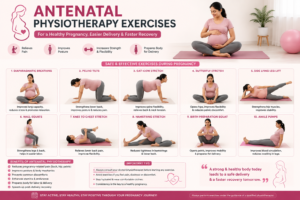
Antenatal Physiotherapy: 7 Exercises Every Pregnant Woman Should Know
Most women in India are told what to eat during pregnancy. They are told which scans to get, which tests to run, which foods to avoid, and which supplements to take. Very few are told about physiotherapy — and that gap quietly makes pregnancy harder than it needs to be.
Antenatal physiotherapy is not a luxury. It is not only for women with “serious” problems. And it is most definitely not about doing exercises from a YouTube video while hoping for the best. It is structured, medically guided physical rehabilitation during pregnancy — and the research behind it is both solid and compelling.
The Uncomfortable Truth About Pregnancy and Pain in India
Back pain during pregnancy is not just “something you have to put up with.”
A study of pregnant women at a tertiary care hospital in southern India found that 42% of women in their second trimester reported low back pain, and 33.7% reported it in their third trimester — with pelvic girdle pain affecting another significant proportion (Prevalence of Musculoskeletal Dysfunctions Among Indian Pregnant Women, PMC).
Globally, the numbers are even higher. A systematic review and meta-analysis published in PMC found the pooled prevalence of lumbopelvic pain during pregnancy to be approximately 45% to 50% of all pregnant women. A separate study from a tertiary hospital reported that 62% of participants experienced low back pain during pregnancy.
Pelvic girdle pain is the most common musculoskeletal condition reported during pregnancy, affecting an estimated 20% of pregnant women globally who seek medical help — with worldwide prevalence ranging from 7% to 84% depending on the diagnostic criteria used, per a 2023 review by Casagrande et al.
Yet the majority of women in India receive no physiotherapy referral. Pain is normalised, movement is restricted out of caution, and months later, many women are left with postpartum pain and pelvic floor problems that were entirely preventable.
What Is Antenatal Physiotherapy?
Antenatal physiotherapy covers the assessment and treatment of all pregnancy-related physical changes — from musculoskeletal pain and pelvic dysfunction to breathing, posture, and preparation for labour.
An antenatal physiotherapist works with you to:
- Assess and treat lower back and pelvic girdle pain
- Prescribe individualised pelvic floor exercises
- Correct postural changes that develop as the belly grows
- Prepare the pelvic floor and perineum for labour
- Manage carpal tunnel syndrome, rib pain, or leg cramps related to pregnancy
- Advise on safe exercise, positions, and activity modifications through each trimester
Why the Pelvic Floor Matters More Than Most Women Realise
The pelvic floor is a group of muscles, ligaments, and connective tissue that forms the base of the pelvis. It supports the uterus, bladder, and bowel — and during pregnancy, it is under constant, increasing pressure as the baby grows.
A Cochrane Review — the gold standard for evidence synthesis — concluded that pelvic floor muscle training (PFMT) during pregnancy effectively reduces postpartum urinary incontinence.
According to a 2020 review by Woodley et al., continent pregnant women who perform supervised antenatal pelvic floor muscle training have a 62% lower risk of reporting urinary incontinence in late pregnancy, and a 29% lower risk up to six months postpartum, compared to those who receive usual care.
There is also evidence for labour outcomes. One randomised controlled trial found that women who completed a structured PFMT programme had a notably lower rate of prolonged second-stage labour (24% versus 38% in the control group) — suggesting that a stronger, better-coordinated pelvic floor can support the birthing process.
7 Evidence-Based Physiotherapy Exercises for Pregnancy
The following exercises are recommended in antenatal physiotherapy practice and are supported by published evidence. Before starting any exercise programme, speak with a physiotherapist who can assess your specific condition, trimester, and risk factors.
Exercise 1: Pelvic Floor Contractions (Kegels)
Why it matters: The foundational exercise for pelvic health during and after pregnancy. Strengthens the muscles that support the bladder, uterus, and bowel, and significantly reduces the risk of urinary incontinence.
How to do it: Sitting or lying comfortably, gently contract the muscles you would use to stop the flow of urine. Hold for 5 to 10 seconds. Fully relax for the same duration. Repeat 10 times.
Physiotherapy note: Many women contract the wrong muscles — the buttocks, thighs, or abdomen — without realising it. A physiotherapist can use biofeedback to confirm you are activating the correct muscles. Research consistently shows supervised PFMT produces better outcomes than self-guided practice.
Exercise 2: Pelvic Tilts
Why it matters: One of the most effective and safest exercises for pregnancy-related lower back pain. Reduces lumbar lordosis and activates deep abdominal muscles without straining the spine.
How to do it: Stand with your back against a wall, feet a few inches forward. Gently flatten your lower back against the wall by tightening your lower abdominals. Hold for 5 seconds, release. Repeat 10 times.
Physiotherapy note: This can also be done on all-fours or lying on your back in early pregnancy. A physiotherapist will guide appropriate positions for each trimester.
Exercise 3: Cat-Cow Stretch (Spinal Mobility)
Why it matters: Particularly helpful for pregnancy-related back pain. Improves spinal mobility, reduces muscle tension in the lower back, and gently activates the deep core muscles.
How to do it: On all-fours, gently arch your back upward (cat), then slowly let it drop downward and lift your head gently (cow). Move slowly and with control. Repeat 10 times.
Physiotherapy note: Avoid this exercise if you have wrist pain or instability. A physiotherapist can suggest modified positions.
Exercise 4: Side-Lying Hip Abduction
Why it matters: Strengthens the hip abductor and gluteal muscles, which are critical for pelvic stability during pregnancy. Weakness in these muscles is strongly associated with pelvic girdle pain.
How to do it: Lie on your side with hips stacked and knees slightly bent. Slowly lift your top leg to about 30 to 40 degrees, keeping your foot parallel to the floor. Lower slowly. Repeat 10 to 12 times per side.
Physiotherapy note: Progress to a resistance band as strength improves. Avoid if this causes or worsens pelvic pain.
Exercise 5: Diaphragmatic (Belly) Breathing
Why it matters: Diaphragmatic breathing supports the coordination of the diaphragm, pelvic floor, and abdominal muscles that provide spinal stability during pregnancy. It also prepares the body for labour breathing techniques.
How to do it: Sitting or lying comfortably, place one hand on your chest and one on your belly. Inhale slowly through the nose, allowing the belly to expand. Exhale slowly through the mouth. Practice for 5 to 10 breath cycles.
Physiotherapy note: The pelvic floor drops gently on inhalation and rises on exhalation. Becoming aware of this connection is a key part of antenatal physiotherapy.
Exercise 6: Supported Wall Squat
Why it matters: Strengthens the quadriceps, glutes, and hip muscles needed for the physical demands of pregnancy and labour. A supported squat also helps open the pelvis and can assist in optimal fetal positioning in later pregnancy.
How to do it: Stand with your back against a wall, feet shoulder-width apart and slightly forward. Slowly slide down until your knees are at roughly a 60 to 70 degree bend. Hold for 5 to 10 seconds, slide back up. Repeat 8 to 10 times.
Physiotherapy note: Avoid deep unsupported squats in the third trimester unless specifically advised by your physiotherapist.
Exercise 7: Perineal Massage (From 34 Weeks)
Why it matters: Research published in a systematic review (Beckmann & Stock, 2013; updated by Yang et al., 2022) found that regular perineal massage from 34 weeks of pregnancy — particularly in first-time mothers — is associated with a reduced risk of episiotomy and perineal trauma during delivery.
How to do it: This technique is taught and guided by a physiotherapist, who will explain the correct positioning, technique, and frequency. It is typically recommended 3 to 4 times per week from week 34 onward.
Physiotherapy note: A physiotherapist will ensure you understand the technique correctly before practising at home.
When Should You Start Antenatal Physiotherapy?
The earlier, the better — but no trimester is too late.
- First trimester: Ideal time to establish a pelvic floor baseline, address any early back pain, and receive guidance on safe activity
- Second trimester: Address pelvic girdle pain, strengthen hips and core, and begin labour preparation
- Third trimester: Perineal massage, optimal fetal positioning, breathing techniques for labour, and pushing strategies
If you are already experiencing back pain, pelvic discomfort, urinary leakage, or tailbone pain at any stage of pregnancy — see a physiotherapist now. These are not conditions to endure until after delivery.
Tele-Physiotherapy: Antenatal Care From Your Home
At Stride Physiotherapy & Rehab, Dr. Shubhangi Sharma provides video-based antenatal physiotherapy consultations — including personalised exercise prescription, pelvic floor assessment guidance, back pain management, and trimester-specific programming — all from the comfort and safety of your own home. You do not have to accept pain as part of pregnancy.
The Bottom Line
Back pain, pelvic girdle pain, bladder leakage, and fatigue during pregnancy are common. They are not, however, inevitable.
Antenatal physiotherapy, grounded in evidence from multiple randomised controlled trials and systematic reviews, can:
- Reduce lower back and pelvic girdle pain significantly
- Decrease the risk of urinary incontinence during and after pregnancy by up to 62%
- Improve pelvic floor coordination and strength for labour
- Reduce episiotomy risk with perineal preparation
- Improve labour outcomes and reduce prolonged second-stage labour
- Prepare your body holistically for delivery and postpartum recovery
You are growing a human being. Your body deserves informed, professional care — not just a pamphlet and a “take it easy.”
Instagram : Facebook : LinkedIn :
📌 Book Your Antenatal Physiotherapy Consultation
At Stride Physiotherapy & Rehab, Dr. Shubhangi Sharma offers personalised antenatal physiotherapy — available in-person and via tele-consultation for pregnant women anywhere in India.
👉 Book your session at stridephysio.co.in
References
Prevalence of Musculoskeletal Dysfunctions Among Indian Pregnant Women. PMC / National Institutes of Health.
Woodley SJ et al. Pelvic Floor Muscle Training for Prevention and Treatment of Urinary and Fecal Incontinence in Antenatal and Postnatal Women. Cochrane Database Systematic Reviews. 2017; updated 2020.
Casagrande D et al. Pelvic Girdle Pain and Pregnancy. 2023 Review.
Beckmann MM, Stock OM. Antenatal Perineal Massage for Reducing Perineal Trauma. Cochrane Database Systematic Reviews. 2013.
Yang et al. Perineal Massage for Prevention of Episiotomy. Systematic Review and Meta-Analysis. 2022.
Zhang et al. Influence of Pelvic Floor Muscle Training During Pregnancy. Acta Obstetricia et Gynecologica Scandinavica. 2023.
Salari N et al. Global Prevalence of Back Pain During Pregnancy. PMC. 2023.