
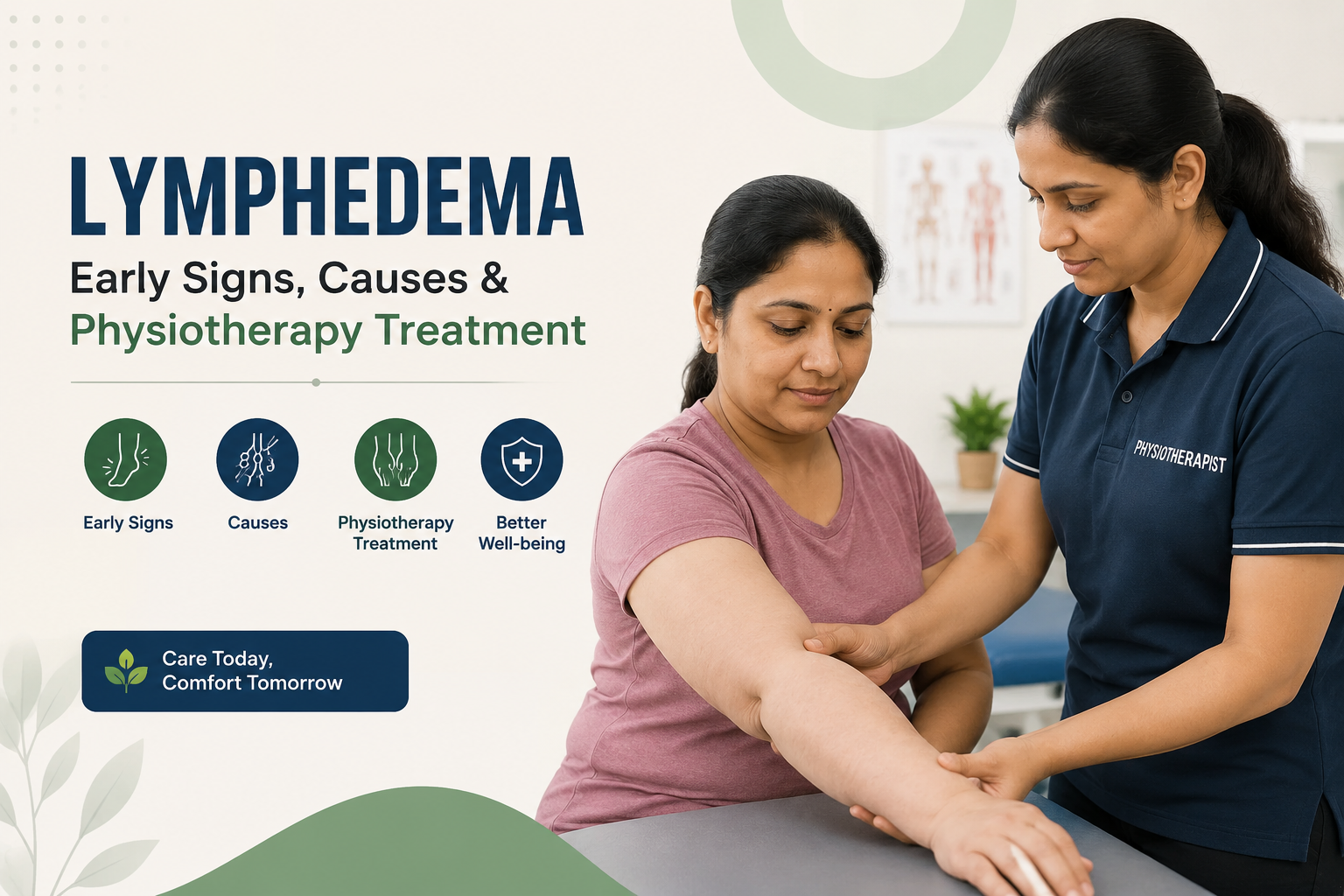
What is Lymphedema? Early Signs, Causes & When to See a Physiotherapist
There’s a kind of swelling that doesn’t go away with rest, elevation, or a good night’s sleep. It stays. It slowly gets worse. And most people in India live with it for months — sometimes years — before anyone tells them what it actually is.
That condition is lymphedema, and it is far more common than you think.
If you or someone you love has noticed persistent puffiness in the arm, leg, face, or chest — especially after a cancer diagnosis, surgery, or infection — this article is for you. No jargon, no scare tactics. Just what you need to know, and what you can do about it.
What Exactly Is Lymphedema?
Your body has two circulatory systems. The one you know is blood — the heart, arteries, veins. The one most people have never heard of is the lymphatic system — a vast network of tiny vessels that drains excess fluid, proteins, and waste from your body’s tissues and returns it to the bloodstream.
When this drainage system is damaged or blocked — due to surgery, radiation, infection, or a developmental issue — fluid starts to back up. It has nowhere to go. It accumulates under the skin, causing swelling that becomes chronic and progressive if not treated.
This is lymphedema.
Unlike regular swelling (edema) that resolves on its own, lymphedema does not. The International Lymphedema Framework defines it as chronic edema present for more than 3 months — and research published in the Lymphatic Research and Biology Journal confirms it is one of the most underrecognised and undertreated conditions globally.
There are two types:
- Primary lymphedema — caused by a developmental problem in the lymphatic system itself, present from birth or appearing later in life.
- Secondary lymphedema — caused by damage to an otherwise healthy lymphatic system, most commonly from cancer treatment, surgery, or parasitic infection.
In India, secondary lymphedema is by far the more common type, and the majority of cases are related to cancer treatment — particularly breast cancer surgery.
How Common Is It? (The Numbers May Surprise You)
Globally, an estimated 250 million people are affected by lymphedema, according to the Lymphatic Education & Research Network. Despite this, awareness remains dangerously low, particularly in low- and middle-income countries like India.
A systematic review and meta-analysis published in BMC Cancer (Torgbenu et al., 2020) — specifically examining lymphedema in low and middle-income countries — found that cancer-related lymphedema is significantly prevalent but consistently underreported due to a lack of standardised diagnostic criteria and limited access to specialist care.
What Are the Early Signs of Lymphedema?
This is where many people miss the window for early intervention. Lymphedema doesn’t always announce itself with dramatic swelling. In fact, the earliest signs are often subtle — easy to dismiss as tiredness or post-surgery recovery.
Watch for these early warning signs:
- A feeling of heaviness or fullness
Before visible swelling appears, many patients describe a sense that their arm, leg, or breast area feels “heavy” or “full” — different from how it normally feels.
- Tightness in the skin
The skin over the affected area may feel tight, almost like it’s being stretched from the inside. Jewellery, sleeves, or socks may suddenly feel too snug.
- Reduced flexibility
You might notice your fingers, wrist, ankle, or knee feel stiffer than usual, with reduced range of motion.
- Mild, intermittent swelling
Early lymphedema often comes and goes — swelling may be worse at the end of the day or after physical activity and better in the morning. Many people assume this is “normal.”
- Aching or discomfort
A dull ache, discomfort, or pins-and-needles sensation in the affected limb can be an early neurological indicator that fluid accumulation is beginning.
- Skin changes
Over time (if untreated), the skin may begin to look thickened, red, or develop a pitting pattern when pressed. This is a sign the condition has progressed.
The critical thing to understand is this: lymphedema caught in Stage 1 is far more manageable than lymphedema in Stage 3. Early physiotherapy intervention can maintain near-normal limb function. Delayed treatment means more complex, longer therapy.
📌 Ready to take the next step?
At Stride Physiotherapy & Rehab, Dr. Shubhangi Sharma offers specialised lymphedema assessment and Complete Decongestive Therapy — both in-person and via tele-consultation for patients across India.
👉 Book your consultation at https://stridephysio.co.in/
What Causes Lymphedema? Understanding Your Risk
Cancer treatment is the most common cause in India. Specifically:
- Breast cancer surgery with lymph node removal — removing axillary nodes disrupts the lymphatic drainage from the arm
- Radiation therapy — radiation causes scarring and fibrosis of lymphatic vessels, reducing their capacity over time
- Chemotherapy — certain chemotherapy agents, particularly taxanes, are known to increase lymphedema risk
- Gynaecological cancers — surgery for ovarian, cervical, or uterine cancer can damage pelvic lymphatics, causing lower limb lymphedema
- Head and neck cancers — lymph node dissection in the neck can cause facial or jaw lymphedema
A 2019 cohort study of 486 breast cancer patients published in JAMA Oncology (Cormier et al.) found that increasing BMI and neoadjuvant chemotherapy duration of 144 days or longer were independently associated with higher lymphedema rates — highlighting how lifestyle factors intersect with medical ones.
The Four Stages of Lymphedema
Understanding staging matters because it directly affects how your physiotherapist will treat you.
Stage 0 (Latent/Subclinical): The lymphatic system is damaged but no swelling is visible yet. Symptoms may include heaviness or mild discomfort. This is the ideal time to begin physiotherapy.
Stage 1 (Mild): Visible soft swelling that improves with elevation. The skin pits when pressed (pitting edema). Fully reversible with appropriate treatment.
Stage 2 (Moderate): The swelling no longer improves with elevation alone. The skin begins to harden (fibrosis starts). Treatment can significantly reduce volume but requires more effort.
Stage 3 (Severe/Lymphostatic Elephantiasis): Significant tissue changes including skin hardening, warty growths, and recurrent infections. Treatment focuses on management rather than reversal.
The message is simple: the earlier you act, the better the outcome.
How Is Lymphedema Diagnosed?
There is no single “test” for lymphedema. Diagnosis is primarily clinical — meaning a trained physiotherapist or doctor will assess you based on:
- Detailed medical history (especially cancer treatment, surgeries, infections)
- Physical examination and limb measurements (circumference or water displacement)
- Symptom assessment
- In some cases, lymphoscintigraphy (a nuclear medicine imaging test) may be used to map lymphatic function
At Stride Physiotherapy & Rehab, assessments are comprehensive and designed to catch lymphedema at the earliest possible stage — including Stage 0 — so that treatment can begin before the condition progresses.
What Causes Lymphedema? Understanding Your Risk
Cancer treatment is the most common cause in India. Specifically:
- Breast cancer surgery with lymph node removal — removing axillary nodes disrupts the lymphatic drainage from the arm
- Radiation therapy — radiation causes scarring and fibrosis of lymphatic vessels, reducing their capacity over time
- Chemotherapy — certain chemotherapy agents, particularly taxanes, are known to increase lymphedema risk
- Gynaecological cancers — surgery for ovarian, cervical, or uterine cancer can damage pelvic lymphatics, causing lower limb lymphedema
- Head and neck cancers — lymph node dissection in the neck can cause facial or jaw lymphedema
A 2019 cohort study of 486 breast cancer patients published in JAMA Oncology (Cormier et al.) found that increasing BMI and neoadjuvant chemotherapy duration of 144 days or longer were independently associated with higher lymphedema rates — highlighting how lifestyle factors intersect with medical ones.
The Four Stages of Lymphedema
Understanding staging matters because it directly affects how your physiotherapist will treat you.
Stage 0 (Latent/Subclinical): The lymphatic system is damaged but no swelling is visible yet. Symptoms may include heaviness or mild discomfort. This is the ideal time to begin physiotherapy.
Stage 1 (Mild): Visible soft swelling that improves with elevation. The skin pits when pressed (pitting edema). Fully reversible with appropriate treatment.
Stage 2 (Moderate): The swelling no longer improves with elevation alone. The skin begins to harden (fibrosis starts). Treatment can significantly reduce volume but requires more effort.
Stage 3 (Severe/Lymphostatic Elephantiasis): Significant tissue changes including skin hardening, warty growths, and recurrent infections. Treatment focuses on management rather than reversal.
The message is simple: the earlier you act, the better the outcome.
How Is Lymphedema Diagnosed?
There is no single “test” for lymphedema. Diagnosis is primarily clinical — meaning a trained physiotherapist or doctor will assess you based on:
- Detailed medical history (especially cancer treatment, surgeries, infections)
- Physical examination and limb measurements (circumference or water displacement)
- Symptom assessment
- In some cases, lymphoscintigraphy (a nuclear medicine imaging test) may be used to map lymphatic function
At Stride Physiotherapy & Rehab, assessments are comprehensive and designed to catch lymphedema at the earliest possible stage — including Stage 0 — so that treatment can begin before the condition progresses.
Can Physiotherapy Actually Treat Lymphedema?
Yes — and it is the gold standard.
The internationally accepted treatment for lymphedema is Complete Decongestive Therapy (CDT), delivered by a certified lymphedema physiotherapist. A clinical study published in Medicine (2020) evaluated CDT across 105 patients and found a median reduction in excess limb volume of 66.5% for upper limb lymphedema and 71.5% for lower limb lymphedema — a remarkable reduction achieved in just 20 sessions over four weeks, with no recorded side effects.
CDT is not a single technique. It is a combination of:
- Manual Lymphatic Drainage (MLD): Gentle, rhythmic skin massage that stimulates the lymphatic system to reroute fluid away from congested areas
- Multi-layer compression bandaging: Applied between MLD sessions to prevent fluid re-accumulation
- Therapeutic exercises: Specific movements that activate the muscle pump to support lymphatic flow
- Skin and nail care: To prevent infections like cellulitis, which worsen lymphedema significantly
This is not something you can self-treat with a regular massage or standard exercise. It requires a physiotherapist trained specifically in lymphology.
When Should You See a Physiotherapist for Lymphedema?
Do not wait until the swelling is severe. See a physiotherapist if:
- You have had breast cancer surgery or any cancer treatment involving lymph node removal
- You notice persistent swelling in any limb or body region, even mild
- You have been treated for filariasis and still experience recurring swelling
- You feel heaviness, tightness, or reduced flexibility in an area that has been treated surgically or with radiation
- You have a family history of lymphedema (primary type)
- Your doctor has mentioned “at risk for lymphedema” but you haven’t received a referral yet
In India, the challenge is awareness. Many oncologists and general practitioners are not routinely referring patients for lymphedema assessment, even when the risk is clearly elevated. If you have undergone breast cancer treatment, you have the right to ask: “Am I at risk for lymphedema, and should I see a physiotherapist?”
Living With Lymphedema: What to Expect
Lymphedema is a chronic condition — there is currently no cure. But “chronic” does not mean “unmanageable.” With the right physiotherapy, many patients maintain near-normal limb function, low swelling, and a good quality of life for years.
Long-term management involves:
- Wearing a compression garment during daily activities and exercise
- Continuing a home exercise programme
- Practising skin care to prevent infections
- Regular follow-up with your lymphedema physiotherapist
- Attending to early signs of flare-ups before they escalate
Patients who begin physiotherapy early and adhere to their home programme consistently do significantly better than those who begin treatment late. The research, the clinical outcomes, and the day-to-day experience of patients confirm this.
The Bottom Line
Lymphedema is not a rare condition. In India, with the rising incidence of breast cancer and limited post-treatment rehabilitation protocols, it is a growing public health concern that remains largely invisible.
If you recognise the early signs in yourself or a loved one — persistent swelling, heaviness, tightness — do not wait. Early physiotherapy intervention can make the difference between a condition that is well-managed and one that significantly diminishes your quality of life.
Stride Physiotherapy & Rehab
Specialized Physiotherapy, Lymphedema Care & Rehabilitation Services.
🌐 Follow Us:
Instagram: @rehab_stride_physiotherapy
Facebook: Stride Physiotherapy & Rehab
X (Twitter): @Stride0105
📌 Ready to take the next step?
At Stride Physiotherapy & Rehab, Dr. Shubhangi Sharma offers specialised lymphedema assessment and Complete Decongestive Therapy — both in-person and via tele-consultation for patients across India.
👉 Book your consultation at stridephysio.co.in