

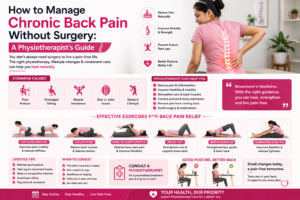
How to Manage Chronic Back Pain Without Surgery: A Physiotherapist’s Guide
Here is something that surprises a lot of people: the vast majority of chronic back pain in India does not need surgery. It does not need lifelong pain medication either. And it almost certainly does not need complete rest.
What it needs — according to the World Health Organisation, the American College of Physicians, and decades of peer-reviewed research — is physiotherapy.
This is not an alternative or fringe view. In 2023, the WHO published specific global guidelines for the non-surgical management of chronic primary low back pain, listing structured physiotherapy and exercise as the cornerstone of care. The same recommendation appears in guidelines from virtually every major medical body worldwide.
How Common Is Back Pain in India? The Numbers Are Striking
A large-scale retrospective study published in PMC (2025), which analysed anonymised electronic medical records from 16,866 patients across 76 private centres in 18 states of India, found that the prevalence of low back pain reached 22.63% in 2023 — its highest point in the five-year study period. Women were significantly more affected than men, accounting for 67.71% of diagnosed cases.
A systematic review and meta-analysis of Indian data reported by Shetty et al. (2022) estimated the annual prevalence of low back pain in India at 51% — meaning roughly one in two adults experiences back pain in any given year. The lifetime prevalence is even higher.
Back pain is the world’s leading cause of years lived with disability, according to the Global Burden of Disease Study 2017. In India, with an ageing population, increasingly sedentary desk-based work, and widespread vitamin D deficiency, the burden is only growing.
What Is Chronic Back Pain? (And What It Is Not)
Acute back pain lasts less than six weeks and often resolves on its own or with basic management.
Chronic back pain is pain that has persisted for 12 weeks or longer. It may be continuous or recurring and significantly affects daily function, sleep, work, and emotional wellbeing.
The WHO defines chronic primary low back pain as “pain and discomfort localising below the costal margin and above the inferior gluteal folds, regardless of referred leg pain, lasting for at least 12 weeks” — where the pain is not fully explained by a specific structural pathology alone.
Most chronic low back pain in India is non-specific, meaning that imaging — X-rays, MRI scans — may not show a clearly identifiable surgical lesion. Research consistently shows that structural findings on scans often correlate poorly with pain levels. Many people with severe disc degeneration on MRI have no pain at all, while others with relatively “normal” scans experience debilitating pain.
This is why surgery often does not fix the problem. And this is precisely why physiotherapy — which addresses the actual drivers of pain including muscle weakness, movement patterns, posture, and neuromuscular control — frequently does.
Why Surgery Is Often Not the Right Answer for Chronic Back Pain
Spinal surgery carries real risks: anaesthesia complications, infection, nerve damage, failed back surgery syndrome, and prolonged recovery. It also has a relatively high rate of recurrence.
A well-cited review published in npj Digital Medicine (Nature, 2023) noted that “exercise-based physiotherapy interventions have often yielded better outcomes for disability and return to work than surgical interventions” for chronic low back pain.
The American Academy of Orthopaedic Surgeons, NICE in the UK, the American College of Physicians, and the WHO all share the same position: non-pharmacological, non-surgical care — primarily physiotherapy and structured exercise — should be the first-line treatment for chronic back pain. Surgery is reserved for clearly indicated cases involving significant neurological compromise or failed conservative management.
What Physiotherapy Actually Does for Chronic Back Pain
A comprehensive review published in PMC (2024) — examining physiotherapy strategies for low back pain using literature from 2017 to 2023 — found that the most effective physiotherapy programmes combine multiple approaches.
Core stabilisation and deep muscle retraining: The deep trunk muscles — particularly the transversus abdominis and multifidus — are consistently found to be underactivated in people with chronic low back pain. Research by Hodges and colleagues established that targeted retraining of these muscles reduces pain and recurrence. This is foundational to evidence-based back physiotherapy.
Manual therapy: Spinal mobilisation and manipulation, when combined with exercise, produce better short-term outcomes than passive treatment alone. Manual therapy helps restore mobility in stiff spinal joints and reduces muscle guarding.
Postural and movement retraining: Many cases of chronic low back pain are driven by habitual movement patterns — sitting positions, lifting mechanics, sleep postures — that repeatedly load the spine poorly. Physiotherapy identifies these patterns and teaches corrective alternatives.
Pain education (neurological pain science education): Chronic pain involves sensitisation of the nervous system, not just tissue damage. Patients who understand this respond significantly better to active rehabilitation. Physiotherapy now includes structured education as a standard part of treatment.
Graded activity progression: Complete rest worsens chronic back pain. The evidence is unambiguous on this. Structured, progressive movement — starting with what is manageable and incrementally increasing — is what produces lasting improvement.
5 Physiotherapy Approaches That Are Evidence-Supported for Chronic Back Pain
1. McKenzie Method (Mechanical Diagnosis and Therapy)
A structured assessment and treatment system that identifies specific movements or positions that reduce or “centralise” referred pain. It has a strong evidence base, particularly for disc-related back pain with referred leg pain.
2. Core Stabilisation Exercises
Based on the foundational research of Hodges, Moseley, and colleagues, these exercises target the deep spinal and abdominal muscles. Programmes begin with gentle activation and progress to functional movement patterns over 6 to 12 weeks.
3. Cognitive Functional Therapy (CFT)
CFT integrates pain education, movement retraining, and behavioural change. A large multicentre randomised controlled trial (O’Sullivan et al., published in JAMA Internal Medicine) found CFT produced superior long-term outcomes compared to both manual therapy and exercise alone.
4. Graded Activity and Graded Exposure
For patients with significant fear of movement — very common in chronic back pain — graded activity programmes gradually reintroduce avoided movements and activities. This directly addresses the fear-avoidance cycle that perpetuates chronic pain.
5. Hydrotherapy and Aquatic Exercise
For patients who find land-based exercise too painful in the initial stages, aquatic physiotherapy reduces spinal loading while still enabling therapeutic movement. Strong evidence supports its use, as noted in the Academy of Orthopaedic Physical Therapy’s 2021 clinical practice guidelines.
What to Expect From Your Physiotherapy Programme
A proper physiotherapy assessment for chronic low back pain should include:
- Detailed history: When pain started, what makes it better or worse, previous treatments, functional limitations, red flag screening
- Movement assessment: Observing your posture, gait, and specific movements to identify contributing patterns
- Neurological screening: Checking reflexes, sensation, and nerve tension signs where indicated
- Strength and flexibility testing: Identifying weaknesses or imbalances contributing to pain
- Goal-setting: What does recovery look like for you? Return to work, sport, sleep, or household tasks?
From this, your physiotherapist builds an individualised programme. You should expect:
- Active involvement — you will be given home exercises to complete between sessions
- Progressive challenge — the programme should gradually increase in difficulty as you improve
- Education — you should understand why each element of your programme is included
- Honest timelines — most chronic back pain requires 8 to 12 weeks of consistent physiotherapy for meaningful improvement
Red Flags: When Surgery May Actually Be Necessary
Physiotherapy is not the answer for every back pain presentation. Certain red flag symptoms require urgent medical evaluation:
- Loss of bladder or bowel control
- Saddle anaesthesia (numbness in the inner thighs and groin area)
- Progressive neurological weakness in the legs (foot drop, inability to stand on toes)
- Severe, unrelenting pain that does not change with position
- History of cancer, significant trauma, or prolonged steroid use with new onset back pain
- Unexplained weight loss combined with back pain
If you have any of these symptoms, see a doctor immediately. For everyone else with chronic, non-specific low back pain, the evidence points clearly in one direction: physiotherapy first.
3 Things to Change for Your Back Pain Today
Stop sitting for more than 45 minutes without moving. Prolonged sitting continuously loads the lumbar spine. Set an alarm if needed — movement breaks matter significantly.
Change how you lift. Most people lift with a rounded lower back. Lifting with a neutral spine and hinging from the hips dramatically reduces spinal load. A physiotherapist can teach this in one session.
Improve your sleep position. Sleeping on your stomach hyperextends the lumbar spine for hours. Side sleeping with a pillow between the knees, or back sleeping with a pillow under the knees, significantly reduces overnight spinal stress.
Tele-Physiotherapy for Back Pain: Getting Expert Care From Home
At Stride Physiotherapy & Rehab, Dr. Shubhangi Sharma offers evidence-based chronic back pain physiotherapy via tele-consultation across India. A video-based assessment can identify postural problems, movement patterns, and exercise needs with remarkable accuracy.
Research published in npj Digital Medicine (Nature, 2023) confirmed that digital and in-person physiotherapy for chronic low back pain produced equivalent improvements in disability outcomes — with higher adherence rates in the digital group.
The Bottom Line
Chronic back pain is India’s most widespread musculoskeletal condition. The evidence is clear and consistent:
- Physiotherapy and exercise are the WHO-endorsed first-line treatment for chronic low back pain
- Exercise-based physiotherapy yields better long-term disability and return-to-work outcomes than surgery in many chronic back pain presentations
- Core stabilisation, manual therapy, pain education, and graded activity — delivered by a trained physiotherapist — produce lasting, meaningful improvement
- Back pain prevalence in India reached 22.63% in 2023 and is rising — making physiotherapy access a genuine public health priority
You do not need to live with back pain. You do not need surgery. What you need is a proper physiotherapy assessment and a structured, individualised programme.
Instagram : Facebook : LinkedIn :
 Book Your Chronic Back Pain Assessment
At Stride Physiotherapy & Rehab, Dr. Shubhangi Sharma offers evidence-based chronic back pain physiotherapy — both in-person and via tele-consultation for patients across India. Visit stridephysio.co.in to book your assessment today.
References
Evaluation of the Prevalence, Trends, and Correlates of Low Back Pain in India: A Retrospective Cross-Sectional Study. PMC. 2025.
Shetty GM et al. Prevalence of Low Back Pain in India: A Systematic Review and Meta-Analysis. 2022.
WHO Guideline for Non-Surgical Management of Chronic Primary Low Back Pain in Adults. Geneva: World Health Organization. 2023.
Hayden JA et al. Exercise Therapy for Chronic Low Back Pain. Cochrane Database of Systematic Reviews. 2021.
Randomized Controlled Trial Assessing a Digital Care Program Versus Conventional Physiotherapy for Chronic Low Back Pain. npj Digital Medicine (Nature). 2023.
Unveiling the Efficacy of Physiotherapy Strategies in Alleviating Low Back Pain: A Comprehensive Review. PMC. 2024.
Interventions for the Management of Acute and Chronic Low Back Pain: Revision 2021. Journal of Orthopaedic & Sports Physical Therapy. APTA. 2021.
Global Burden of Disease Study 2017: Low Back Pain Prevalence and Years Lived with Disability.